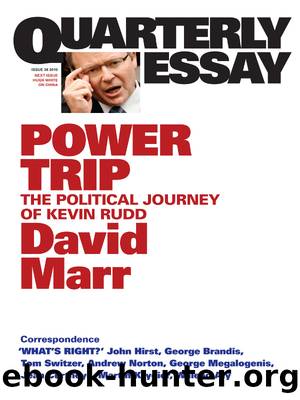
Quarterly Essay 38 Power Trip: The Political Journey of Kevin Rudd by David Marr
Author:David Marr [Marr, David]
Language: eng
Format: epub
Tags: Historical, Biography, Biography & Autobiography, Political Science, World, Writing, Australian & Oceanian, Political, Politics
ISBN: 9781921825378
Google: 6WHiAAAAQBAJ
Goodreads: 18267643
Publisher: Black Inc.
Published: 2010-06-01T00:00:00+00:00
WHATâS RIGHT? Correspondence
John Hirst
John Howard was the first Australian prime minister to call himself conservative. In Australian political commentary, conservatism is usually seen as laughable or sinister and Howardâs espousal of it made denunciation of him easier. It is refreshing, then, to find Waleed Aly and the Quarterly Essay taking conservatism seriously and even quoting Howard approvingly. But this is merely a softening-up process; the criticism of Howard soon resumes because, according to Aly, Howard was not a true conservative: he was a neo-conservative. Following other critics, Aly posits a fundamental contradiction between Howardâs so-called conservatism and his commitment to a free economy, or neo-liberalism in Alyâs clas-sification. An unrestrained capitalism will have a destructive effect on the social order, so conservatives who are also neo-liberals are undermining what they should be protecting and nurturing. Faced with social dissolution of their own making, they respond with strident nationalism and pressures for conformity, and thus show themselves to be not true conservatives but neo-conservatives. This is neat, but it wonât survive scrutiny.
Consider these measures of social policy, which Howard implemented:
⢠Work for the dole
⢠Tough on drugs
⢠Against gay marriage
⢠In favour of fathers having better access to children after divorce
⢠Intervention in Aboriginal communities in the Northern Territory
⢠Single mothers to re-enter the workforce sooner
⢠Better support for families and mothers wanting to stay at home with children
How many of the situations to which these policies were directed were the result of neo-liberal policies in the economy? On my count: none. In different ways they were responding to the libertarian social revolution of the 1960s and 1970s, which was strong in Australia while the economy was still closely regulated. These policies were properly conservative in that they were not trying to restore the status quo but to limit the revolutionâs effects. So single mothers are not to be stigmatised or denied government help, but they are not to model for their children a life lived on welfare. Homosexuals are not again to be criminals; they can have partners recognised by the state, but they cannot marry. Divorce is to continue on a no-fault basis, but the feminist bias of the Family Court is to be controlled.
Aly makes only one reference to what he calls the sexual revolution, although of course it was a much wider revolution than that. He considers the argument that the recent sexualisation of children might be an effect of the sexual revolution of several decades ago. He rejects this view because the effect is so long delayed; it must therefore be the result of neo-liberalism, which allows business to break any taboo for profit. Of course business has been making money out of the social revolution since it manufactured Che T-shirts and pre-faded jeans. And it is an odd view of a social movement to think its effects must be instantaneous. Social systems have a huge inertia. First a man and a woman might live openly together without being married; after two decades two men may
Download
This site does not store any files on its server. We only index and link to content provided by other sites. Please contact the content providers to delete copyright contents if any and email us, we'll remove relevant links or contents immediately.
| Arms Control | Diplomacy |
| Security | Trades & Tariffs |
| Treaties | African |
| Asian | Australian & Oceanian |
| Canadian | Caribbean & Latin American |
| European | Middle Eastern |
| Russian & Former Soviet Union |
The Secret History by Donna Tartt(19086)
The Social Justice Warrior Handbook by Lisa De Pasquale(12190)
Thirteen Reasons Why by Jay Asher(8909)
This Is How You Lose Her by Junot Diaz(6886)
Weapons of Math Destruction by Cathy O'Neil(6279)
Zero to One by Peter Thiel(5801)
Beartown by Fredrik Backman(5754)
The Myth of the Strong Leader by Archie Brown(5507)
The Fire Next Time by James Baldwin(5444)
How Democracies Die by Steven Levitsky & Daniel Ziblatt(5218)
Promise Me, Dad by Joe Biden(5153)
Stone's Rules by Roger Stone(5087)
A Higher Loyalty: Truth, Lies, and Leadership by James Comey(4962)
100 Deadly Skills by Clint Emerson(4925)
Rise and Kill First by Ronen Bergman(4788)
Secrecy World by Jake Bernstein(4753)
The David Icke Guide to the Global Conspiracy (and how to end it) by David Icke(4717)
The Farm by Tom Rob Smith(4507)
The Doomsday Machine by Daniel Ellsberg(4490)
